
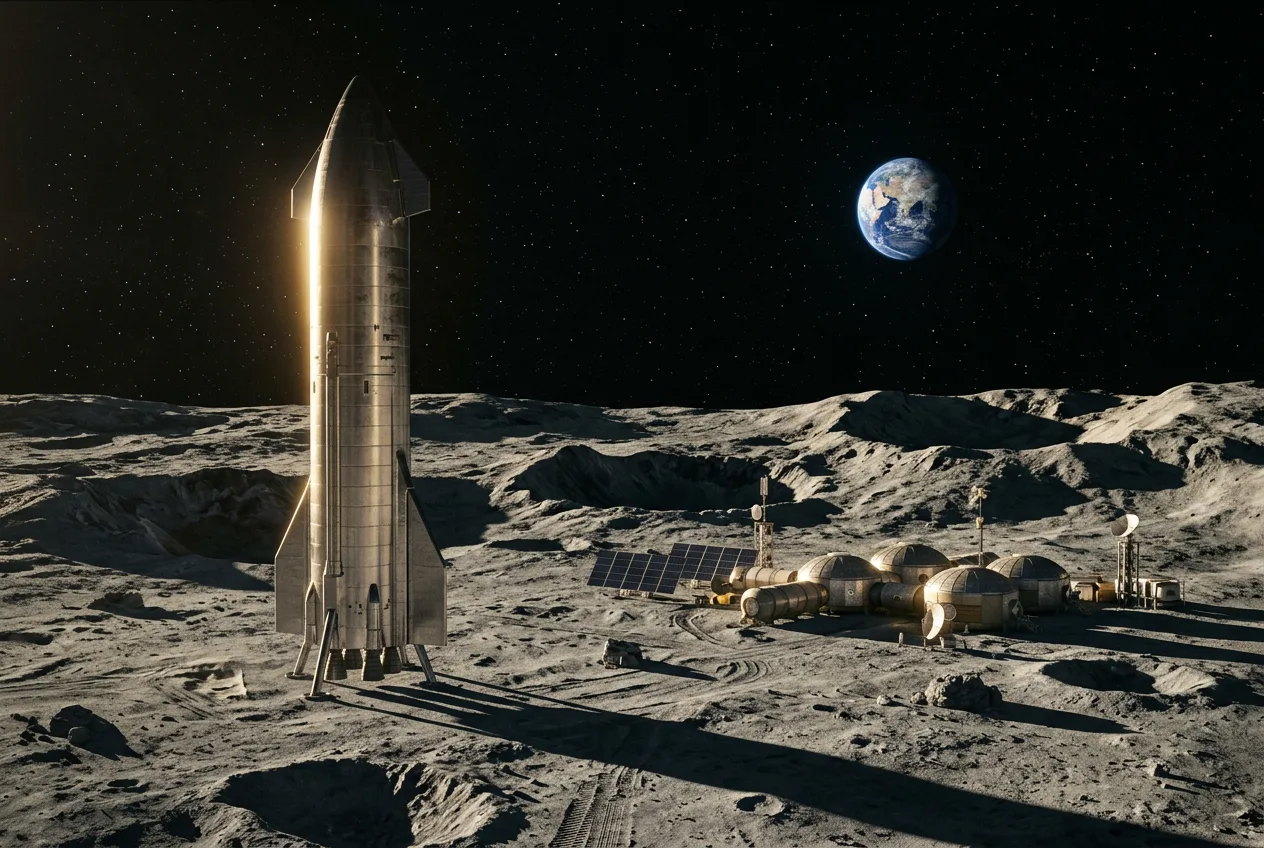
Image: Illustration created with AI
In February 2026 Elon Musk put Mars on hold and told SpaceX to aim for the Moon instead. Here is what he wants to build, how Starship fits in, and how realistic the timeline is.
For more than twenty years Elon Musk has said that SpaceX exists to get people to Mars. Then, on 9 February 2026, he changed course. SpaceX, he said, would now focus on building a "self-growing city" on the Moon, something he believes can be done in less than ten years. Mars, which he expects to take more than twenty, has been pushed back by about five to seven years.
It is the biggest change of direction in the company's history, and it puts the Moon back at the centre of the new space race.
Why the Moon, and why now
The short answer is distance. The Moon is about three days away. Mars is six months or more, and the planets only line up for a launch roughly once every 26 months. That means a Mars programme gets one chance to test, learn and try again every two years or so.
The Moon is different. Musk has pointed out that ships could leave for the Moon about every ten days. For a company whose whole method is to build, fly, break things and improve them quickly, that is a huge advantage. Every lesson learned on the Moon, from landing heavy ships to keeping people alive on another world, would also feed into the eventual trip to Mars.
What the city would look like
SpaceX has not published detailed plans, but the outline Musk has given goes well beyond a few astronauts in a tent. The base, often referred to as Moon Base Alpha, is meant to grow by making more and more of what it needs from the Moon itself, rather than shipping everything from Earth.
The most eye-catching part of the idea is industry. Musk has spoken about factories on the Moon building satellites for artificial intelligence computing, and launching them into space with an electromagnetic mass driver, a long track that flings objects off the surface using electricity rather than rockets. On Earth that would be impossible because of the thick atmosphere and strong gravity. On the Moon, with no air and one-sixth of Earth's gravity, it becomes a serious engineering idea.
Starship is the key
None of this works without Starship, the giant fully reusable rocket SpaceX has been testing in Texas. A version called Starship HLS (Human Landing System) is already being built for NASA as a lunar lander. It is 52 metres tall, stands on the Moon like a building, and uses a lift to bring astronauts down to the surface.
The hardest part is fuel. To reach the Moon, a Starship must be refuelled in Earth orbit by a series of tanker flights, possibly around ten of them, launched in quick succession. Nobody has ever moved rocket fuel between two ships in space on this scale.
Progress in 2026 has been real but bumpy:
- On 28 September 2026, on its fourteenth test flight, Starship reached orbit for the first time and released 26 Starlink satellites, although the flight ended early after an engine shut down too soon.
- SpaceX has started building a real crew cabin for the lunar lander, with life support, power and avionics.
- NASA's latest schedule, presented in October 2026, puts the first ship-to-ship refuelling test in early 2027.
How it fits with NASA's Artemis missions
SpaceX's Moon plans are tied closely to NASA's Artemis programme. In 2021 NASA paid SpaceX 2.89 billion US dollars to develop Starship as the lander that would return astronauts to the Moon. After delays, NASA reshaped the plan in February 2026:
| When | What is planned | |---|---| | Early 2027 | First Starship refuelling test in Earth orbit | | Mid 2027 | Artemis III: four astronauts in Orion practise docking with test versions of Starship and Blue Origin's Blue Moon lander in Earth orbit | | Late 2027 | Uncrewed Starship landing on the Moon as a demonstration | | Early 2028 | Artemis IV: the first crewed Moon landing since 1972 |
The Artemis III crew has already been named: Randy Bresnik, Frank Rubio and Andre Douglas of NASA, and Luca Parmitano of the European Space Agency. NASA has not yet decided whether Starship or Blue Moon will carry the Artemis IV astronauts down to the surface, so SpaceX is, in effect, racing Jeff Bezos for the honour.
The sceptics
Musk's timelines have a habit of slipping. In 2016 he talked about landing people on Mars by 2025, and as recently as 2024 he planned to send uncrewed Starships to Mars in 2026. Neither happened. In October 2026 Reuters reported that both lunar landers were running behind, and NASA has planned a series of reviews to check whether they will be ready.
Building a city is also far harder than landing a ship. Settlers would need protection from radiation, a way to cope with sharp lunar dust that damages seals and lungs, and power through the lunar night, which lasts around 14 Earth days. And under the 1967 Outer Space Treaty, no country can claim the Moon as its territory, so the question of who governs a private city there is still wide open.
Why it matters
Whether or not the city arrives on Musk's schedule, the change in direction matters. The world's most active rocket company has decided that the Moon, not Mars, is where the next chapter of human life beyond Earth begins. For the first time in more than fifty years, ships built to carry people to the lunar surface are being finished and tested, and the next few years could see footprints, landers and perhaps the first permanent buildings appear on the Moon.
We will be following every step here in the Moon Journal.