
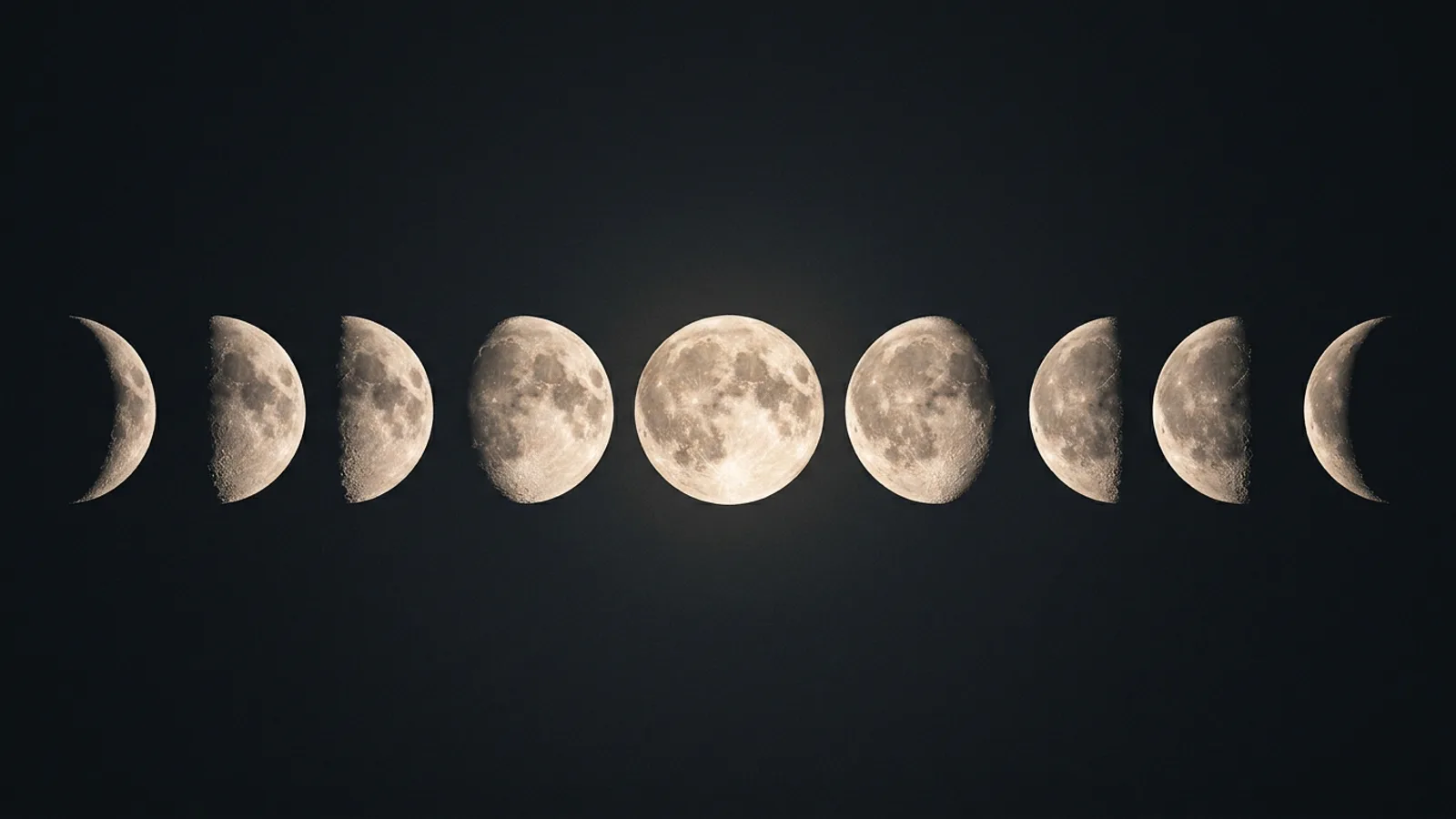
Image: Illustration created with AI
Every full moon from October 2026 to October 2027, from the Beaver Moon onwards, plus the supermoons, eclipses and other moons worth looking up for.
Every new moon, quarter and full moon from October 2026 to October 2027, with the traditional name of each full moon and the nights worth putting in the diary. All dates and times are UK time (GMT, or BST in summer). The exact moment of each phase is the same everywhere in the world, so if you are elsewhere, adjust the clock time for your own time zone.
The Moon takes about 29.5 days to go from one new moon to the next. At new moon it sits between the Earth and the Sun and is almost invisible. It then grows night by night to first quarter, when half of it is lit, and on to full moon, when the whole face we see is lit. After that it shrinks back through last quarter to the next new moon.
The full moons at a glance
- Tuesday 24 November 2026, 2:53 pm: Beaver Moon (supermoon)
- Thursday 24 December 2026, 1:28 am: Cold Moon (supermoon)
- Friday 22 January 2027, 12:17 pm: Wolf Moon (supermoon)
- Saturday 20 February 2027, 11:23 pm: Snow Moon (penumbral lunar eclipse)
- Monday 22 March 2027, 10:43 am: Worm Moon
- Tuesday 20 April 2027, 11:27 pm: Pink Moon
- Thursday 20 May 2027, 11:58 am: Flower Moon (seasonal Blue Moon)
- Saturday 19 June 2027, 1:44 am: Strawberry Moon
- Sunday 18 July 2027, 4:44 pm: Buck Moon (micromoon)
- Tuesday 17 August 2027, 8:28 am: Sturgeon Moon (micromoon, penumbral lunar eclipse)
- Thursday 16 September 2027, 12:03 am: Harvest Moon
- Friday 15 October 2027, 2:47 pm: Hunter's Moon
Supermoons
A supermoon is a full moon that happens when the Moon is near the closest point of its oval orbit. It can look up to 14% larger and around 30% brighter than a full moon at its furthest. There are 3 in the year ahead:
- Tuesday 24 November 2026: the Beaver Moon, about 360,800 km away
- Thursday 24 December 2026: the Cold Moon, about 356,800 km away
- Friday 22 January 2027: the Wolf Moon, about 357,600 km away
The closest of all is the Cold Moon on Thursday 24 December 2026. The best time to see the size difference is just after moonrise, when the Moon is low on the horizon next to trees and buildings.
Micromoons
The opposite of a supermoon: a full moon near the furthest point of the Moon's orbit, when it looks slightly smaller and dimmer than usual. The Buck Moon on Sunday 18 July 2027 is about 406,000 km away. The Sturgeon Moon on Tuesday 17 August 2027 is about 405,100 km away.
Blue Moons
Despite the name, a Blue Moon is not blue. The phrase has two meanings: the second full moon in a calendar month, or the third full moon in a season that has four. The Flower Moon on Thursday 20 May 2027 is a seasonal Blue Moon: there are four full moons this spring instead of the usual three, and it is the third.
The Harvest Moon and the Hunter’s Moon
The Harvest Moon is the full moon closest to the autumn equinox, and this time it falls on Thursday 16 September 2027. Around the equinox the Moon rises only a little later each evening than the night before, so there are several bright, moonlit evenings in a row just after sunset. The Hunter’s Moon follows on Friday 15 October 2027. It was traditionally the moon to hunt and store food by before winter set in.
Eclipses
Eclipses only happen at a new moon (solar eclipses) or a full moon (lunar eclipses), and only when the Sun, Earth and Moon line up almost exactly. In the year ahead:
- Saturday 20 February 2027, 11:23 pm: a penumbral lunar eclipse at the Snow Moon, when the Moon passes through the faint outer edge of Earth’s shadow, so it dims only slightly. The Moon is up in the UK at the time, so it should be visible if the sky is clear.
- Tuesday 17 August 2027, 8:28 am: a penumbral lunar eclipse at the Sturgeon Moon, when the Moon passes through the faint outer edge of Earth’s shadow, so it dims only slightly. The Moon is below the horizon in the UK at the time, so it will not be visible from there.
- Saturday 6 February 2027: an annular solar eclipse, when the Moon is too far away to cover the Sun completely, leaving a bright "ring of fire" along a narrow path. Only part of the world sees it, so check whether your area is included. Never look at the Sun directly without proper eclipse glasses.
- Monday 2 August 2027: a total solar eclipse, when the Moon covers the Sun completely along a narrow path, with a partial eclipse seen over a much wider area around it. Only part of the world sees it, so check whether your area is included. Never look at the Sun directly without proper eclipse glasses.
Where the moon names come from
The full moon names used here are the ones popularised by the Old Farmer’s Almanac. They draw on Native American, colonial American and old European folk traditions, and each describes what was happening in nature at that time of year. Different cultures have their own names, and many traditions have several for the same moon.
- Beaver Moon: beavers are busy finishing their dams and lodges before the freeze.
- Cold Moon: it shines over the longest, coldest nights of the year.
- Wolf Moon: said to be named after wolves heard howling through the long winter nights.
- Snow Moon: February is often the snowiest month of the northern winter.
- Worm Moon: earthworms return to the surface as the ground thaws.
- Pink Moon: named after pink wild phlox, one of the first spring flowers in North America. The Moon itself does not turn pink.
- Flower Moon: named for the flowers that bloom everywhere in late spring.
- Strawberry Moon: it marks the short wild strawberry season.
- Buck Moon: male deer grow their new antlers at this time of year.
- Sturgeon Moon: sturgeon were once most easily caught in the Great Lakes in late summer.
- Harvest Moon: it is the full moon closest to the autumn equinox. For several evenings in a row it rises soon after sunset, which once gave farmers extra light to bring the harvest in.
- Hunter's Moon: traditionally the time to hunt and store food before winter.
Month by month
Every principal phase of the Moon in the year ahead.
November 2026
- Last quarter: Sunday 1 November, 8:28 pm
- New moon: Monday 9 November, 7:02 am
- First quarter: Tuesday 17 November, 11:47 am
- Full moon (Beaver Moon): Tuesday 24 November, 2:53 pm
December 2026
- Last quarter: Tuesday 1 December, 6:08 am
- New moon: Wednesday 9 December, 12:51 am
- First quarter: Thursday 17 December, 5:42 am
- Full moon (Cold Moon): Thursday 24 December, 1:28 am
- Last quarter: Wednesday 30 December, 6:59 pm
January 2027
- New moon: Thursday 7 January, 8:24 pm
- First quarter: Friday 15 January, 8:34 pm
- Full moon (Wolf Moon): Friday 22 January, 12:17 pm
- Last quarter: Friday 29 January, 10:55 am
February 2027
- New moon: Saturday 6 February, 3:56 pm
- First quarter: Sunday 14 February, 7:58 am
- Full moon (Snow Moon): Saturday 20 February, 11:23 pm
- Last quarter: Sunday 28 February, 5:16 am
March 2027
- New moon: Monday 8 March, 9:29 am
- First quarter: Monday 15 March, 4:25 pm
- Full moon (Worm Moon): Monday 22 March, 10:43 am
- Last quarter: Tuesday 30 March, 1:53 am
April 2027
- New moon: Wednesday 7 April, 12:51 am
- First quarter: Tuesday 13 April, 11:56 pm
- Full moon (Pink Moon): Tuesday 20 April, 11:27 pm
- Last quarter: Wednesday 28 April, 9:17 pm
May 2027
- New moon: Thursday 6 May, 11:58 am
- First quarter: Thursday 13 May, 5:43 am
- Full moon (Flower Moon): Thursday 20 May, 11:58 am
- Last quarter: Friday 28 May, 2:57 pm
June 2027
- New moon: Friday 4 June, 8:40 pm
- First quarter: Friday 11 June, 11:56 am
- Full moon (Strawberry Moon): Saturday 19 June, 1:44 am
- Last quarter: Sunday 27 June, 5:54 am
July 2027
- New moon: Sunday 4 July, 4:02 am
- First quarter: Saturday 10 July, 7:38 pm
- Full moon (Buck Moon): Sunday 18 July, 4:44 pm
- Last quarter: Monday 26 July, 5:54 pm
August 2027
- New moon: Monday 2 August, 11:05 am
- First quarter: Monday 9 August, 5:54 am
- Full moon (Sturgeon Moon): Tuesday 17 August, 8:28 am
- Last quarter: Wednesday 25 August, 3:27 am
- New moon: Tuesday 31 August, 6:41 pm
September 2027
- First quarter: Tuesday 7 September, 7:31 pm
- Full moon (Harvest Moon): Thursday 16 September, 12:03 am
- Last quarter: Thursday 23 September, 11:20 am
- New moon: Thursday 30 September, 3:36 am
October 2027
- First quarter: Thursday 7 October, 12:47 pm
- Full moon (Hunter's Moon): Friday 15 October, 2:47 pm
- Last quarter: Friday 22 October, 6:29 pm
Watching the full moon
A full moon looks full for a night or so either side of the exact moment, so if the sky is cloudy on the night, try the evening before or after. It rises in the east at about sunset and sets in the west around sunrise, so it is up all night. This calendar is refreshed every six months to always cover the year ahead.


